
.avif)
Scaling Beyond POC
Many organisations run successful AI proof-of-concepts (POCs), but only a small number manage to turn those initiatives (or experiments) into solutions that work reliably in day-to-day operations. A POC shows that an idea can work in a controlled environment, but it doesn’t guarantee that it will deliver value at scale - consistently!
To move from experimentation to real impact, teams need the right processes, tools, and governance in place. You need to measure the right metrics and have the right operating model to monitor quality and finetune the solution.
Why POCs Don’t Scale on Their Own
POCs are designed to answer small, specific questions quickly. They usually rely on limited datasets, simplified integrations, and relaxed operational requirements.
But production environments are different. They involve:
- constantly changing data,
- complex systems that need to work together,
- less predictable user collaborations,
- consistent and quality output over a longer period,
- performance expectations from users, and
- governance requirements such as security and compliance.
This is why a successful POC does not automatically turn into a successful production system.
Experiment: Test Quickly but Test Smart
In the experimentation stage, a Proof of Concept (POC) helps you test ideas, understand data you are working with, and identify potential benefits. The mistake many organisations make is treating a POC like a simple demo; something built fast, with ideal conditions, and no consideration for what happens next.
A smart experiment looks beyond whether the model works once, and instead asks:
- How will the model behave with real, messy, constantly changing data?
POCs usually use clean datasets. Real operations do not.
- Are there risks, biases, or unintended outcomes hidden in the data or logic?
It’s better to detect these issues early, when the model is small and manageable.
- How will this connect to the systems people actually use?
A promising model is useless if it can’t integrate into the workflow.
- Who will use it, monitor it, and maintain it over time?
Every AI system needs someone accountable for its outcomes.
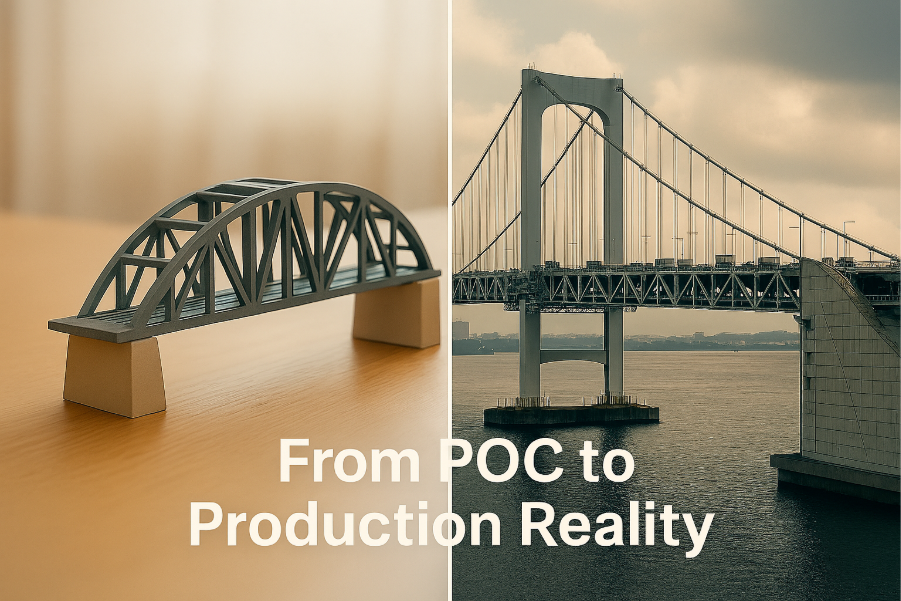
As an example, think of a POC as building a small model bridge. It shows whether the design is promising i.e. the structure holds, the shape works, and the idea is sound. It helps you answer: Should we continue?
But a real bridge is very different from a model bridge. It needs to handle, real traffic, withstand weather elements, comply with safety standards, be maintained over years, etc. A model bridge does not need any of that. It only needs to prove the idea.
A POC works the same way. It proves the concept, but it doesn’t prove whether the system will survive real load, real risk, and real complexity. At best, it’s a ticket to explore further.
That’s why experimentation must be fast, but also smart. It's not about proving an idea, it’s about gathering the insights needed to build the real bridge later.
Operationalise: The Most Important Step
Once the POC proves the idea works, the next challenge is turning it into something reliable enough for everyday use. This is where many AI projects stall, not because the model is bad, but because the organisation isn’t ready for what comes next.
Operationalising an AI solution means building the infrastructure, processes, and checks required to run it safely and consistently. This is where MLOps plays a crucial role.
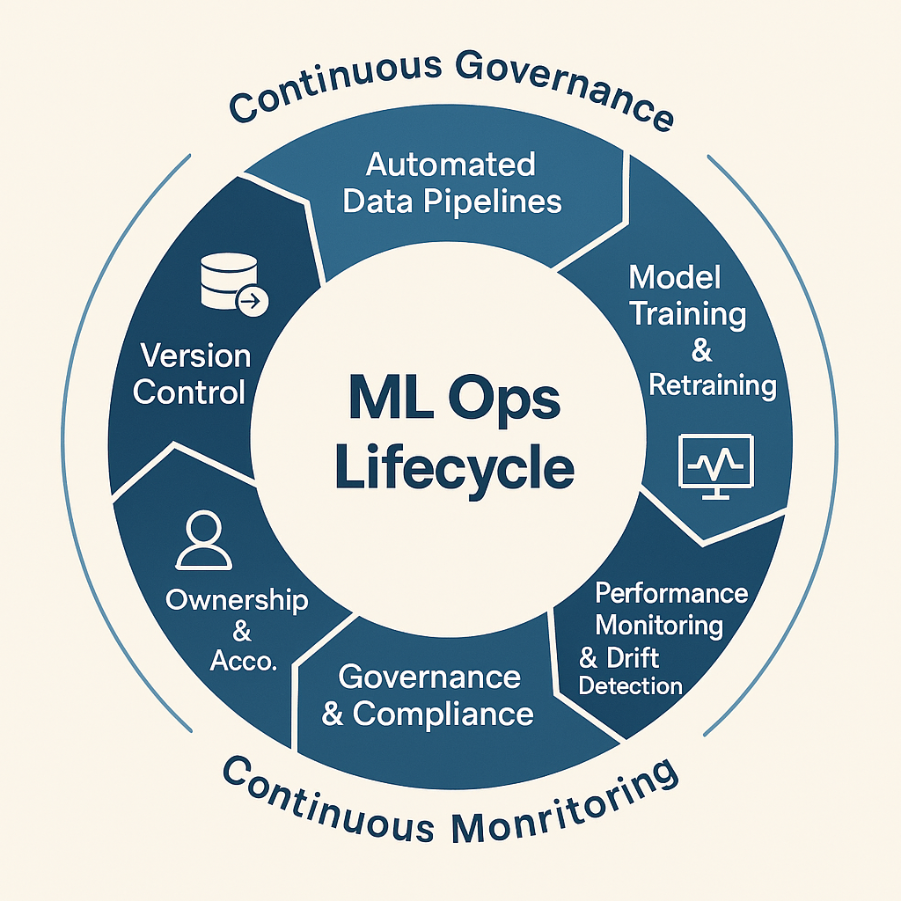
Operationalisation involves:
- Automated data pipelines
So the model always receives the right data in the right structure, without manual fixes.
- Version control for models and data
So changes are tracked, reversible, and auditable.
- Monitoring for performance and drift
Models naturally degrade over time; monitoring ensures issues are detected early.
- Retraining processes
So the model can adapt as patterns in the data evolve.
- Clear ownership and responsibilities
Someone must be accountable for the model's health and outcomes.
This stage requires engineering teams, data teams, and business teams to coordinate which is why it’s often the toughest. The costs can also add up.
If the POC was a model bridge, operationalisation is the phase where you start constructing the full-scale bridge. This step now requires engineers, safety checks, material standards, compliance, long-term maintenance planning, and real-world simulations.
A model bridge can be built on a desk. A real bridge requires foundations, permits, inspections, and engineering discipline.
This is exactly what operationalisation does for AI. It transforms a promising idea into a safe, stable, real-world system.
Scale: Build for Real-World Use, Not Just a Single Test
Scaling is the point where AI moves from a single successful deployment to a repeatable, reliable capability across the organisation. Scaling is about creating an environment where AI can grow without breaking.
To scale well, organisations need:
- Reliable, well-governed data
AI collapses quickly without consistent, trustworthy inputs.
- Smooth integration into business systems
Models must connect seamlessly to where decisions are made.
- Continuous monitoring
Ensuring the model stays accurate, fair, and aligned over time.
- Strong governance
So decisions remain safe, compliant, and explainable at scale.
Scaling succeeds when the foundations are strong enough to support multiple use cases, multiple contexts, and ongoing change.
Once the full bridge is built, it still isn’t ready for the public. Before opening day, engineers must run load tests, verify safety protocols, confirm the bridge can handle constant use, etc. Only then can the bridge handle thousands of vehicles, varying weather, long-term wear, and unexpected pressures.
Scaling AI is the same. It’s like ensuring that the bridge you built remains safe, dependable, and resilient under real-world conditions.
ROI Realignment after POC: The Real Value
Many organisations struggle to realise tangible ROI from AI projects, especially after a successful POC. That is due to the nature of POCs and lack of appreciation of production quality solutions. They lead to unclear or incorrect ROI metrics, cost surprises, stalled projects, and solutions blocked by security or compliance teams. The process of realignment may also lead to iterations of the solution, including optimisation and model changes or tweaks.
To realign ROI after the POC stage:
- Understand and refine the actual cost of the solution
- Realign with strategic goals, understand risk and quality metrics
- Ensure security, ethical, and regulatory requirements are fully considered
- Re-evaluate the ROI metrics and gain acceptance.
By realigning ROI after the POC, organisations can unlock the full value of AI investments.
Continuous Governance: The Safety Net
AI systems do not remain accurate or safe on their own. Governance ensures that models are reviewed, monitored, and controlled throughout their lifecycle.
This includes:
- tracking how models make decisions,
- ensuring fairness and transparency,
- managing risks, and
- meeting regulatory or ethical expectations.
In conclusion, a POC is only the beginning. Real value comes from the ability to turn successful experiments into solutions that can run reliably, improve over time, and remain safe.
If your organisation is ready to move beyond experimentation and realise the full value of AI, Alkemiz can help. Our team of experienced advisors and technologists specialise in AI strategy, governance, and implementation, supporting you from initial assessment to value realisation. Let’s talk about your goals.
Reach out to: connect@alkemiz.com.au
Let’s build the future together.
Ready to transform your business with solutions driven by empathy, excellence, and innovation?

